
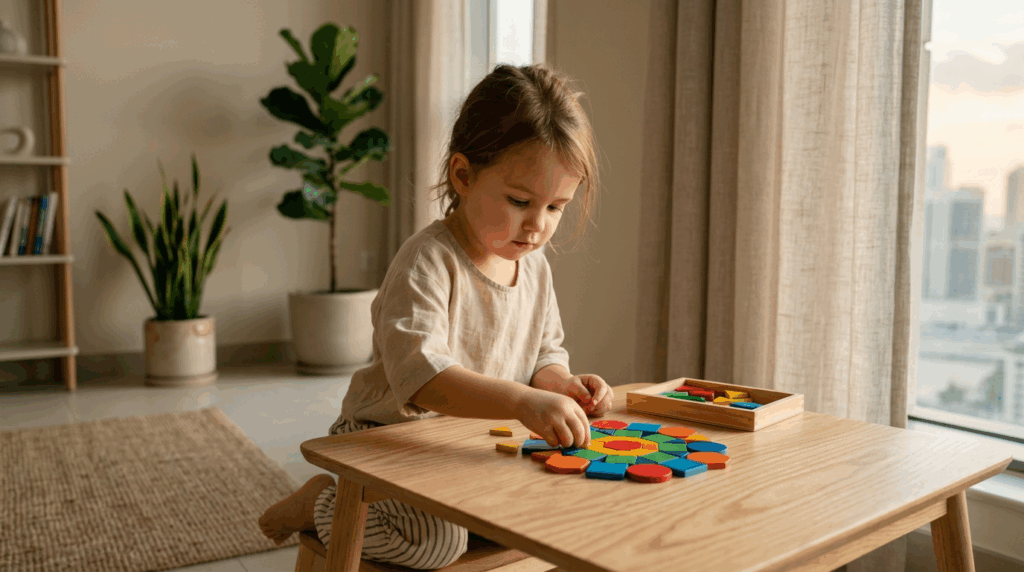
Every April, the world turns blue for Autism Awareness Month, and few cities embrace the moment quite like Dubai. From the Burj Khalifa to the Dubai Frame, landmarks across the emirate light up to honour individuals on the autism spectrum and the families who love them. But awareness is more than a colour. For parents in the UAE, it means knowing the early signs, understanding how the brain develops differently, and finding the right support at the right time.
At Talking Brains Center, we work with children and families navigating Autism Spectrum Disorder (ASD) every day. This guide brings together what every parent and educator in the UAE should know: what autism is, how it shows up, what the latest research says, and how early intervention, especially in speech and language, can change a child’s trajectory.
Key takeaways
Autism Spectrum Disorder (ASD) is a lifelong neurodevelopmental condition that influences how a person perceives the world, communicates, and connects with others. The word spectrum matters: no two autistic individuals are alike. Some need significant daily support; others live, work, and thrive independently while still experiencing the world differently.
Common traits associated with autism include:
Autism also brings real strengths. Many autistic individuals show exceptional memory, deep focus on subjects they love, strong pattern recognition, honesty, and creative problem-solving. The goal of awareness is not to fix autism, but to understand it well enough to support each person to flourish on their own terms.
Published research estimates that Autism Spectrum Disorder affects approximately 1 in 146 births in the United Arab Emirates, although regional benchmarking studies suggest the real prevalence is higher and that many children remain undiagnosed. Globally, prevalence has been climbing for years, driven largely by improved screening, broader diagnostic criteria, and growing awareness rather than a sudden change in the condition itself.
The UAE has responded with one of the most ambitious inclusion agendas in the region. The National Policy for Empowering People of Determination, the “My Community… A City for Everyone” initiative, and the UAE’s Year of Community have transformed how autism is understood, accommodated, and supported in everyday public life.
In 2025, Dubai became the first Certified Autism Destination in the Eastern Hemisphere. Over 70,000 staff across hotels, attractions, and transport have been trained in autism and sensory awareness. Dubai International Airport was the world’s first autism-certified airport, and Emirates the world’s first autism-certified airline. Mercato Mall, the Mohammed Bin Rashid Library, Children’s City, the Etihad Museum, and many more public spaces now hold Autism-Friendly Certification.
For families in Dubai and across the Emirates, this means that the world outside the home is becoming far easier to navigate. The next step is making sure children get the right clinical support early in life, when it makes the biggest difference.
Autism can be reliably identified by age two, and signs often appear earlier. The signs below are common indicators, but only a qualified specialist can diagnose autism. If several of these resonate, an assessment is the right next step, not a wait-and-see approach.
| Age | Possible Signs to Watch For |
|---|---|
| By 12 months | Limited eye contact, no babbling or pointing, no response to name being called |
| By 18 months | No single words, limited shared attention, lack of gestures such as waving or showing |
| By 24 months | No two-word phrases, loss of words previously used, repetitive movements, intense focus on parts of objects |
| 3 to 5 years | Difficulty with conversation, pretend play, or making friends; strong reactions to sensory input; rigid routines |
| School age | Trouble understanding sarcasm or figurative language, struggles with group dynamics, difficulty managing transitions |
Bilingual children growing up in the UAE between Arabic, English, and other home languages may show typical bilingual delays that are sometimes confused with autism. A speech-language pathologist trained in bilingual assessment can help families distinguish the two.
The first five years of life are when the brain is most adaptable. Neural pathways for language, social interaction, and emotional regulation form rapidly during this window, which is exactly why early intervention has such a strong evidence base.
A large-scale study found that therapy delivered around the age of 3.8 years produced the strongest outcomes for children on the autism spectrum. That does not mean later therapy is ineffective, far from it, but every month of well-targeted support during early childhood compounds.
Effective early intervention is rarely a single therapy. It usually combines:
Communication is at the centre of how a child experiences the world. For autistic children, language and social communication often develop along a different timeline, and speech-language pathology is one of the most powerful tools we have to support that development.
At Talking Brains Center, our therapists work on:
For children who are minimally verbal or non-speaking, the priority is giving them a way to express needs, choices, and feelings. This may involve speech, gestures, picture-based systems, or assistive communication apps that turn taps into spoken words.
Therapists scaffold word learning, sentence building, and comprehension in both Arabic and English when relevant, building on the child’s interests rather than against them.
This includes turn-taking in conversation, recognising emotions in others, asking questions, and reading non-literal language such as humour and sarcasm.
Children learn to label what they feel and ask for what they need, which reduces meltdowns triggered by communication breakdown rather than by the situation itself.
Concerned about your child’s communication?
A speech and language assessment is the first step toward clarity. Our team in Dubai works in English and Arabic, and we tailor every session to the child sitting in front of us.
Book an assessmentAutism science has moved fast in the last decade. A study from Stanford Medicine found that children with autism process emotional tones in voices differently because of variations in a brain region linked to social interaction. This kind of research is reframing how we think about therapy: not as correcting the brain, but as building bridges around how it naturally works.
Other promising developments include:
The cultural conversation around autism has shifted as more public figures speak openly about being on the spectrum. Actor Bella Ramsey, known for The Last of Us, has described their autism diagnosis as freeing and credits learning social interactions consciously with making them a stronger performer. Singer and artist Grimes has spoken about being diagnosed with autism and ADHD, reflecting that earlier diagnosis would have helped her navigate school and social environments with less struggle.
When public figures share these stories, families across the UAE and beyond hear something important: autism is not a limit on what a life can become.
If something feels off, trust that instinct. Acting early is always better than waiting.
Awareness only matters if it changes how we behave with each other. Whether you are a parent, teacher, employer, or neighbour in the UAE, small choices add up.
Published research estimates autism affects roughly 1 in 146 births in the United Arab Emirates, though regional benchmarking studies suggest the true prevalence is likely higher and underdiagnosed compared with countries that have advanced screening systems. The UAE has invested significantly in awareness, screening, and inclusive services in recent years to close that gap.
Common early signs include limited eye contact, delayed speech or loss of previously used words, not responding to their name by 12 months, repetitive movements such as hand-flapping or rocking, intense focus on specific objects, and difficulty with changes in routine. Sensory sensitivities to sound, light, or texture are also frequent indicators.
Research shows that early intervention is most effective when therapy begins around age three to four, but support can start as early as 18 months when concerns are flagged. The earlier therapy begins, the more the brain’s natural plasticity can be used to build communication, social, and language skills.
Yes. In 2025, Dubai became the first Certified Autism Destination in the Eastern Hemisphere, with autism-friendly designations across Dubai International Airport, Emirates Airlines, Burj Khalifa, Mercato Mall, Mohammed Bin Rashid Library, and dozens of other public venues. The wider My Community… A City for Everyone initiative continues to expand sensory-friendly spaces across the emirate.
Speech therapy supports children with autism by building functional communication, expanding vocabulary, developing social language skills such as turn-taking and reading facial expressions, and introducing assistive communication tools when verbal speech is limited. Therapy is tailored to each child’s profile, sensory needs, and communication style.
Autism assessments in Dubai are available through specialised centres staffed by developmental paediatricians, psychologists, and speech-language pathologists. Talking Brains Center provides communication and language assessments as part of a multidisciplinary approach, and can refer families to partner specialists for full diagnostic evaluations when needed.
Every child deserves to be heard, in their own way
If you have questions about your child’s speech, communication, or development, we are here to help. Talking Brains Center supports families across Dubai and the UAE in English and Arabic.
Get in touch with our team