
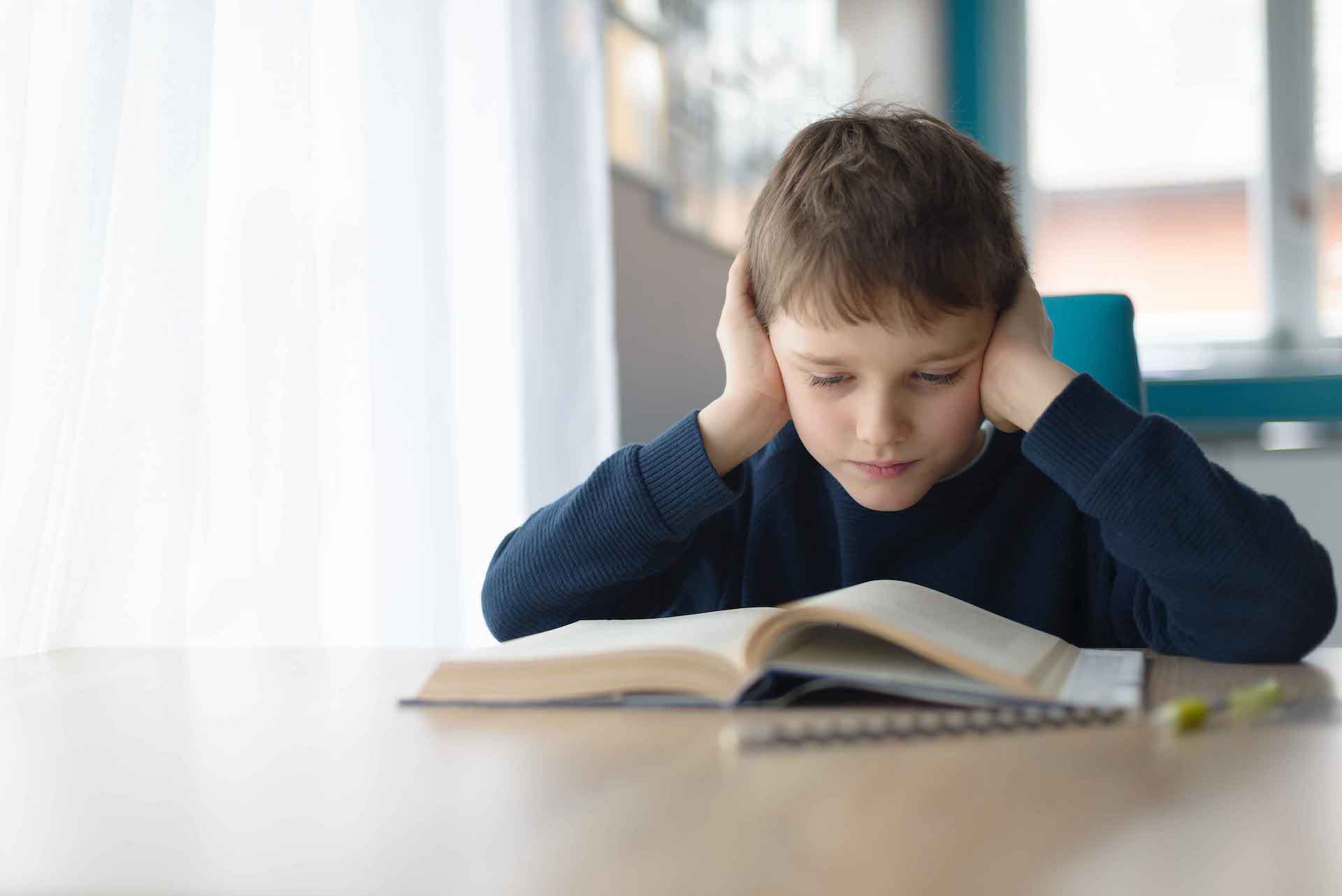
The dyslexia – dysorthographia is a learning disability specific to reading and writing. It occurs in children with mid or high intelligence, pursuing a normal scholar education and having non sensorial disorders (auditory or visual).
Dyslexia, usually a hereditary condition, is one of the main causes of school dropout. If the child is bilingual then dyslexia appears in both languages in general.
The diagnosis of dyslexia-dysorthographia can’t be assured before the age of 7 or 8 years old. The written language access difficulties appearing before this age are just some early signs which may lead to dyslexia-dysorthographia. An early intervention may prevent these disorders from development.
The inaccuracies vary from one child to another, but in general these are the most frequent:
- Slow, difficult and inaccurate reading of the detached words;
- Exhaustion signs after a short reading;
- Substitution of similar appearance words, even though it may change the sentence’s meaning
- Substitution of one word by a synonym which has nothing to do with the right word
- Some difficulties with the short key words
- Omission or changes in the suffixes
- Inversion or adding some letters and syllables;
- Visual confusion such as b/d, p/q, m/n… or auditory confusion such as f/v, t/d, s/z…
Reading problems might be manifested in other domains such as:
- Copying: slow and incorrect. The child confuses, inverts, forgets some letters, syllables or words, joins two words… he loses his place in the text, returns back, writes the same thing twice, and forgets what he should write.
- Spelling: usually dyslexia is accompanied by dysorthographia or spelling disorder. Dictations and writings are full of spelling mistakes. The student adds letters, inverts, omits, makes some mistakes in transitions, mixes up homophones, converts the irregular and used words incorrectly. The child can easily write the same word in two different ways in the same article. Spelling mistakes are persistent despite the repetitive dictations done at home.
- Handwriting: usually unreadable. The child misuses the page space: unusual spacing between words, no respect of the margins, sentences stacked on one part of the page instead of splitting them in a uniform way…
- Written comprehension: the child doesn’t understand neither the exercises’ questions, nor the problem statement he should read. However, he is able to answer correctly if we read them to him.
- Memorizing: The child faces some difficulties in memorizing a written article. On the contrary, he memorizes easily an oral article but sometimes the working memory is weak even orally.
- Spatial orientation: The child faces some difficulties while learning or memorizing words that indicate orientation: for instance, left-right, over-under, before-after, high-low, in front of-behind of, east-west.
- The confusion between right and left is manifested especially in writing and in mathematics: he mixes up b/d, p/q, symbols<>, and the order to solve the operations…
- He faces some difficulties in reading or following maps and plans. He tends to get lost whenever he is visiting a new place.
- Spatial organization: The child has some difficulties in organizing his physical space. He generally prefers to pile his stuff instead of organizing and arranging them.
This disorganization invades all his personal space: room, table, handbag, bag… He tends to lose various personal objects and to forget the needed material to do his homework.
- Orientation and temporary organization: dyslexic child faces some difficulties in esteeming the adequate time to accomplish a task. He tends not to submit his homework on time, because he doesn’t evaluate properly the adequate time to finish a task; he is usually mistaken the day or week when using his agenda. He has also difficulties in remembering the hour and telling it through the use of an analogic watch (hand watch).
- Studying by heart some non-comprehensive scripts (uninteresting or impersonal documents) is extremely hard for the majority of dyslexic children.
At school, it is even difficult to teach them the multiplication table, the scientific facts, historical facts, dates, names and places. Dyslexic students get higher results in history courses related to events, their origins, causes and effects, than studying by heart dates and names. - Mathematics difficulties: Usually, the dyslexic child is talented in mathematics. His good ability in three-dimensional vision helps him identifying mathematics concepts faster and clearer than other students.
Unfortunately, the difficulties faced in orientation and memorization complicate the mathematics tasks such as memorizing while adding and subtracting, learning the multiplication table, and understanding the divisions .
Recent researches suggest that it’s an inherited disorder.
Dyslexia comes from a neurological difference, or in other words from a different brain functioning. The right cerebral hemisphere is bigger in dyslexic people than in other readers.
This fact can explain why dyslexic persons are usually talented when it comes to domains controlled by the right hemisphere.
Dyslexic persons don’t use the brain part associated to reading as others do. This function is assumed by another part of their brain.
Recent studies also suggest another cause which is, the lack of phonemic awareness: children are unable to distinguish or manipulate various sounds constituting syllables or spoken words. If a child lacks phonemic awareness, then he will face difficulties in adjusting the relation between letters of one word and their sounds (graphemes). It will also be difficult for him to apply the relationship between letters and sounds in order to pronounce the sounds that compose an unknown word.
- Language delay (e.g.a one-year-old child who doesn’t pronounce any word);
- Mixing –up between the various sounds in a multi-syllabic word (for example “aminal” – “animal”, “cocholat” – “chocolat”, and “gymtasmique” – “gymnastique”);
- Inability to make rhymes at the age of four years old;
- A huge number of allergies or reactions against childhood diseases;
- Inability to tie his shoes;
- Mixing-up between left and right, over and under, before and after, in addition to other terms and orientation conceptions;
- Difficulty in learning the alphabet letters or the related sounds, and writing these letters in order.
- Some may think that the ability to read is related to intelligence; however, we meet some dyslexic children of high or mid intelligence.
- Dyslexia is uncommon; however recent studies show that one in five children suffers from dyslexia.
- Children recover from dyslexia by getting older; in fact, the child will resort frequently to palliative mechanisms, but he won’t be able to read well.
- Dyslexia is not a vision disorder, therefore visual trainings, ocular accommodation exercises and dark glasses will not solve the problem.
- Not all the children who mix up between b and d or p and q are necessary dyslexic children.
- Daily and systematic reading will not help a dyslexic child to attain a better reading.
- Lack of attention’ span is not necessarily accompanied by dyslexia; each one of them is to be diagnosed separately. However, research has proved that some dyslexic persons also suffer from a lack of attention or hyperactivity disorders.
It is certain that attention disorders disrupt reading development; they may appear through slowness due to multiple hesitations or a high tension tendency interfering during the reading process.
- Photosensitivity (light sensitivity): a limited number of dyslexic persons (between 3 to 8 %) suffer also from photosensitivity. Some of them hardly distinguish little printed characters in black on a white sheet of paper and have the impression that these characters move or shake slightly, while others tend to dislike fluorescent lighting and to hide their paper by their hand or head while reading.
In some countries, it is the speech pathologist responsibility to treat dyslexia without healing it completely, since there are no miracle solutions. But treatment is the key to helping a dyslexic child; it can be extended from one till three years according to the case and the treatment frequency.
10 or 15% of dyslexic children improve a little bit or do not improve at all; thus the speech pathologist could use various strategies with each child. He will let him improve his sounds perception, his phonemic awareness, and his visual memory of words (so as to being able to photograph the word’s image) …
The speech pathologist will attempt to give the child some tricks and tips to remedy his bad spelling mistakes, to cover the topic in a better comprehension, to create automatisms and to regain confidence in his learning capacity.
Usually, committed spelling, memorizing and reading mistakes are misunderstood by the child since he considers them illogical and stupid. They will embarrass him psychologically so that he will put them aside without trying to understand them and consequently, accepting the outside judgement. There will be no possible argumentation since he is unconscious of his mistakes. Add to that, the student will suffer because his efforts are not rewarded.
Among teachers, dyslexia usually causes unfavorable judgement; among parents, anger and anxiety are added; among friends, mockery appears; and within the child himself, a deep feeling of depreciation appears.
It is extremely important that the educators (parents and teachers) understand the written language disorder and help the child to flourish. It is highly recommended to encourage and appreciate each and every accomplished improvement. In some cases, psychological support is essential.
Dyslexic persons were proved to be talented in the domains controlled by the brain’s right hemisphere, such as artistic talent, musical talent, and three-dimensional vision, talent in mechanics, imagination, athletic dispositions, global and creative thought, mathematics conceptualization, curiosity, tenacity, and awareness.
Some dyslexic persons have succeeded due to their talents, in developing their potential to the maximum, such as: Steven Spielberg, Tom Cruise, Jack Nicholson, Sylvester Stallone, Robin Williams, Winston Churchill, Benjamin Franklin, Beethoven, John Lennon, Mozart, Thomas Edison, and Albert Einstein.
The child, whose dyslexia is detected at an early age and controlled effectively, will be more comfortable with written language. If he is already failing in school, the diagnosis will help him understanding his difficulties and consequently the treatment process will start. Dyslexic child integration in the mainstream is facilitated when his scholar and family environment assures comprehension, support and appreciation.
At TBC, our Lebanese Speech & Language Therapists in Dubai, UAE, conduct therapy sessions in Arabic, French, and English, focusing on assisting clients with dyslexia. We offer specialized occupational therapy, psychomotor, and speech therapy services aimed at helping individuals navigate and overcome the challenges associated with dyslexia.