

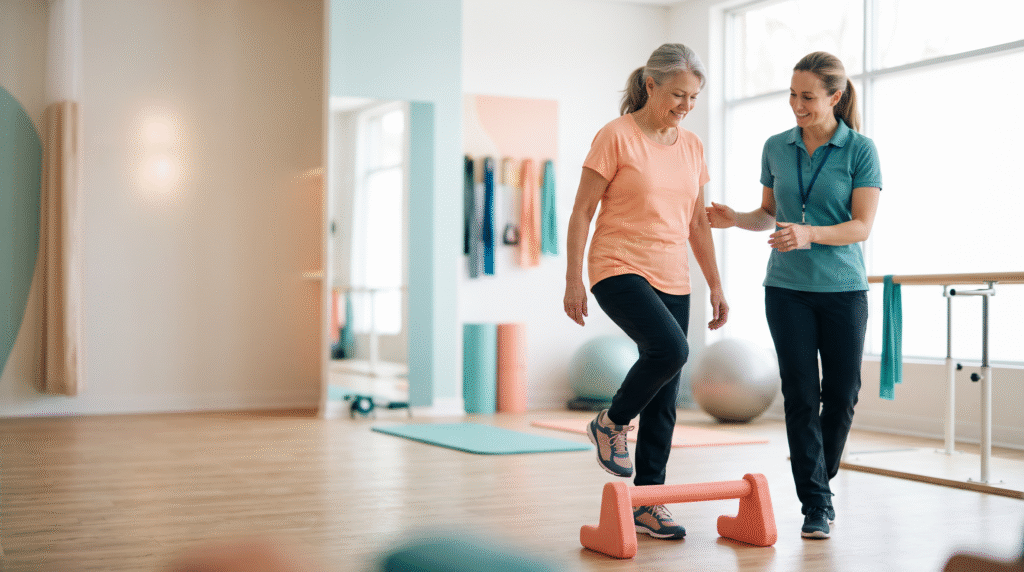
Growing older should not mean giving up the activities you love. Good balance is something we can continue to work on, at any age.
"I don't feel as steady as I used to."
"I avoid taking the stairs because I'm afraid of falling."
"I used to enjoy walking outside, but now I prefer staying home."
These are concerns we often hear when working with older adults.
A small loss of balance, a fall, or even the fear of falling can gradually change someone's daily routine.
Activities that once seemed simple may become stressful. Some people begin avoiding movement, going out less often, or relying more on family members.
But there is something important to remember:
Losing your balance is not something you simply have to accept as part of getting older.
Although changes in strength, coordination, and reaction time may occur with age, there are effective ways to improve balance and reduce the risk of falling.
Balance is much more complex than standing on two feet.
Every time we stand, walk, turn, or reach for something, several parts of our body work together.
For example, when you walk across an uneven surface, your brain constantly makes small adjustments to keep you stable.
With age, some of these processes may become slower or less efficient. Certain medical conditions, medications, vision difficulties, or muscle weakness can also increase the risk of falling. This is why balance deserves attention, even before a first fall happens.
Psychomotor therapy focuses on the relationship between movement, body awareness, attention, and emotions.
These are all important when it comes to maintaining balance in daily life.
As psychomotor therapists, we are interested not only in whether someone can stand or walk, but also in how they organise their movements and respond to different situations.
For example:
These observations help us understand what may be affecting their movement and confidence.
Sometimes, a person may have difficulty sensing exactly where their feet, legs, or body are positioned. Through carefully selected activities, we work on recognising body position, adjusting posture, and controlling movements. The aim is to help the person move with greater awareness and stability.
Balance training is not limited to standing on one leg.
It can involve practising everyday movements, such as:
Exercises are selected according to the person's abilities and performed with appropriate support or supervision.
Have you ever noticed that walking becomes more difficult when you are distracted?
For some older adults, walking while talking, looking for something, or carrying an object can become challenging. Our brain needs to manage several activities at the same time.
Psychomotor therapy may include exercises that combine movement and attention, helping the person practise managing these everyday situations.
For someone at risk of falling, these activities must be introduced gradually and under appropriate supervision.
After experiencing a fall, some people become afraid to move.
This fear is understandable. However, avoiding activities may gradually lead to reduced strength, less movement, and even greater difficulty maintaining balance.
In therapy, we take these feelings seriously.
By introducing achievable challenges, respecting the person's pace, and recognising small improvements, we help them feel more comfortable with movement.
Regaining confidence is an important part of returning to daily activities.
Yes. Research shows that appropriate exercise programmes can reduce falls among older adults. Programmes that challenge balance and include functional movements, often combined with strength training, are particularly helpful.
Walking is beneficial for general health, but walking alone may not provide enough balance training for someone at risk of falling. Effective fall-prevention programmes are usually practised regularly, at least three times a week, progressed gradually, and continued over several months.
The right exercises, frequency, and level of supervision should always be adapted to the individual.
Balance training is important, but falls can have several contributing causes.
It is also helpful to:
If you have already fallen, experienced repeated near-falls, or noticed a new change in your balance, speak with a healthcare professional. Sudden weakness, difficulty speaking, or other new neurological symptoms require urgent medical attention.
Every older adult has a different story, a different rhythm, and different goals. Some people want to continue taking their daily walks. Others hope to move more safely at home, go shopping independently, or feel comfortable joining family activities again.
Through individualised psychomotor assessment and therapy, we work on movement, coordination, body awareness, attention, and confidence. When needed, this support forms part of a broader fall-prevention plan involving medical care and other rehabilitation professionals.
Our objective is not to make every person move in the same way.
It is to help each person make the best possible use of their abilities.
Because maintaining balance is not just about avoiding a fall. It is about preserving the freedom to move, participate, and enjoy life.
Changes in strength, coordination, and reaction time may occur with age, but losing your balance is not something you simply have to accept. There are effective ways to improve balance and reduce the risk of falling, at any age.
Psychomotor therapy works on body awareness, coordination and balance, attention during movement, and confidence. Exercises are adapted to the person's abilities and performed with appropriate support or supervision.
Effective fall-prevention programmes are usually practised at least three times a week, progressed gradually, and continued over several months. The right exercises, frequency, and supervision should be adapted to each person.
Walking is beneficial for general health, but walking alone may not provide enough balance training for someone at risk of falling. Programmes that challenge balance and include functional movements, often combined with strength training, are particularly helpful.
Speak with a healthcare professional if you have already fallen, experienced repeated near-falls, or noticed a new change in your balance. Sudden weakness, difficulty speaking, or other new neurological symptoms require urgent medical attention.
If you or a loved one has noticed changes in balance, or has started avoiding activities for fear of falling, our psychomotor therapy team in Dubai is here to help with an individualised assessment.
Book an AppointmentWritten by: Marie-Noelle Ngoviky
Reviewed by: Joevana El Howayek