

Summer is a season of adventure, exploration, and quality family time, but it can also leave parents wondering how to maintain their child’s progress in speech, language, learning, or motor skills while taking a break from school routines. The good news? Meaningful learning doesn’t have to happen through worksheets or structured therapy sessions.
Research consistently shows that children learn best through play-based learning and everyday interactions with caring adults. Whether you’re at the beach, in the park, cooking together, or simply enjoying a quiet afternoon at home, ordinary moments can become powerful opportunities to support speech and language development, cognitive skills, fine and gross motor skills, and social-emotional growth, all while your child is simply having fun.
Play is far more than entertainment, it’s one of the most effective ways children learn. Through play, they develop communication skills, strengthen memory and attention, improve problem-solving, build coordination, practice self-regulation, and learn how to interact with others. When adults join in, respond to a child’s interests, and gently expand on their ideas, these everyday interactions become rich learning experiences that support development across multiple domains.
Below are ten simple, parent-friendly ways to make therapy almost invisible this summer, each one easy to weave into the moments you already share as a family.
Children learn best when they’re engaged in activities they genuinely enjoy. Whether they’re fascinated by water play, insects, construction toys, pretend cooking, or collecting seashells, their interests naturally encourage communication and curiosity.
Rather than directing every activity, join your child’s play. Follow their lead, listen to their ideas, and build conversations around what captures their attention. Motivation is one of the strongest drivers of learning.
It’s tempting to turn every moment into a question: “What colour is this?” “What’s that called?”
While questions certainly have their place, too many can make conversations feel like a test. Instead, model language by making comments:
Commenting introduces new vocabulary, encourages spontaneous conversation, and reduces pressure, making communication feel more natural and enjoyable.
Learning happens when children are gently encouraged beyond what they already know. You might invite your child to:
These small challenges strengthen language, memory, reasoning, and confidence without taking away the fun.
Movement supports much more than physical fitness, it also helps develop the brain. Activities such as climbing, balancing, dancing, throwing, catching, running, or creating simple obstacle courses promote gross motor skills, motor planning, and coordination, along with attention, executive functioning, and self-regulation. These foundational skills support success in communication, learning, and everyday independence.
You don’t need expensive toys or carefully planned activities to support development. Daily routines offer countless opportunities for learning. Packing a picnic, grocery shopping, preparing meals, watering plants, or travelling together can all encourage children to:
These natural conversations strengthen vocabulary, comprehension, and flexible thinking while fitting seamlessly into family life.
Many parents worry that repeating the same game or reading the same book over and over will become boring. In reality, repetition is one of the most effective ways children learn. Revisiting favourite stories, songs, and pretend games helps strengthen speech production, vocabulary, language comprehension, memory, and confidence. Children often notice new details each time they repeat an activity, making familiar experiences powerful opportunities for growth.
When children encounter a challenge, it’s natural to want to help immediately. Instead, try pausing for a few seconds before stepping in. Simple prompts such as “What could we try?”, “How else could we build it?”, or “What’s your plan?” encourage problem-solving, planning, flexible thinking, and independence. Sometimes, giving children time to think is more valuable than giving them the answer.
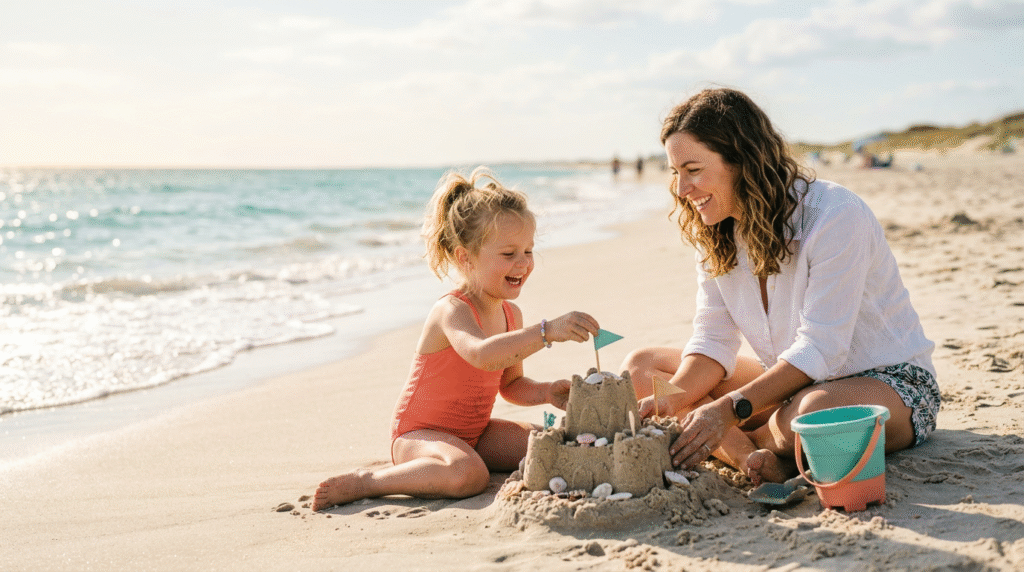
One of the greatest strengths of play-based learning is that a single activity can support multiple areas of development at the same time. Building a sandcastle, for example, works across nearly every skill area:
| Skill area | How building a sandcastle helps |
|---|---|
| Speech | Practising sounds while communicating |
| Language | Describing, requesting, sequencing, and storytelling |
| Cognitive skills | Planning, remembering, problem-solving, and flexible thinking |
| Motor skills | Digging, scooping, pouring, carrying, and hand coordination |
| Social skills | Sharing, turn-taking, and cooperating with others |
Play naturally integrates learning in ways that isolated exercises often cannot.
Some of the richest learning happens when adults know when to step in, and when to step back. Allow your child to lead imaginative play while gently introducing new vocabulary, asking open-ended questions, or adding small challenges that encourage thinking. This balance nurtures creativity, confidence, communication, and independence while keeping play enjoyable.
Children won’t remember perfectly planned activities. They’ll remember feeling heard, encouraged, and connected. Warm, responsive interactions are among the strongest predictors of healthy communication, emotional well-being, and lifelong learning. Sometimes the most valuable “therapy session” is simply laughing together while building a tower, reading a favourite story, or exploring the outdoors.
Use this easy five-step rhythm on your next trip to the park, beach, or market:
Repeat the cycle naturally throughout the outing. No preparation, worksheets, or special materials required.
Everyday play and routines are ideal. Follow your child’s interests, comment more than you question, add small challenges, and turn outings, meals, and chores into conversations. These natural interactions support speech, language, cognitive, motor, and social development without feeling like therapy.
Play is one of the most effective ways children learn. Through play they build communication, memory, attention, problem-solving, coordination, and self-regulation. When a caring adult joins in and gently expands on the child’s ideas, ordinary play becomes a rich, evidence-based learning experience.
That’s a good thing. Repetition strengthens speech production, vocabulary, comprehension, memory, and confidence, and children usually notice new details each time. Familiar, repeated activities are powerful opportunities for growth, not a sign of boredom.
If you have ongoing concerns about your child’s communication, learning, motor development, or overall progress, it’s worth speaking with a specialist. An early intervention or assessment can clarify your child’s needs and guide next steps, and the earlier support begins, the more effective it tends to be.
This summer, let play be your child’s greatest teacher. By following their interests, encouraging meaningful conversations, embracing movement, and making the most of everyday experiences, you can naturally support speech, language, cognitive, motor, and social development, without making it feel like therapy.
At Talking Brains Center in Dubai, we believe that every playful moment is an opportunity to learn. If you have concerns about your child’s communication, learning, motor development, or overall development, our DHA-licensed multidisciplinary team is here to support your family with individualized, evidence-based intervention that helps children thrive through meaningful, engaging experiences. Contact us today to book a consultation.