

Every year, hundreds of thousands of children and adolescents worldwide are diagnosed with cancer. According to the International Agency for Research on Cancer (IARC), more than 275,000 children and young people aged 0–19 were diagnosed with cancer worldwide in 2024.
Thanks to major advances in childhood cancer treatment, survival rates have improved dramatically over the past few decades. But surviving cancer is only part of the story. For some children, cancer and its treatment can have lasting effects on communication, speech, language, learning, cognitive skills, motor development, and social interaction.
During Childhood Cancer Awareness Month, we want to highlight an aspect of childhood cancer that receives less attention: how cancer and cancer treatment can affect a child’s communication and overall development, and how speech-language pathologists and psychomotor therapists can support children and their families throughout treatment and recovery.
Cancer itself and treatments such as chemotherapy, radiation therapy, and surgery can affect a child’s developing brain and body.
The impact varies depending on the type and location of the cancer, the child’s age at diagnosis, and the intensity and type of treatment. However, several challenges may occur:
Brain tumors can directly affect areas of the brain involved in understanding and producing language.
Head and neck cancers, as well as surgery or radiation involving these areas, can affect a child’s voice, speech clarity, and ability to swallow safely.
Chemotherapy, particularly treatment involving the central nervous system, can be associated with difficulties involving memory, attention, processing speed, and executive functioning. These cognitive changes are sometimes referred to as “chemo brain.”
Prolonged hospitalization can reduce a young child’s exposure to everyday conversation, social interaction, and play, all of which play an important role in early language and communication development.
Research also suggests that more complex, higher-order language skills may be particularly vulnerable. These include understanding jokes, idioms, figurative language, ambiguity, and other forms of non-literal communication.
Importantly, some communication and cognitive difficulties may not become apparent immediately. They can emerge years after cancer treatment, particularly as children grow and the language, social, and academic demands placed on them become more complex.
For this reason, ongoing developmental and communication monitoring after childhood cancer treatment is important, rather than relying only on a single assessment after treatment ends.
The impact of childhood cancer can look different depending on the child’s developmental stage.
Toddlers and younger children may experience delays in reaching early speech and language milestones. Families may also notice regression in previously acquired skills, such as toilet training, as well as changes in behavior, sleep, or mood.
At this age, behavioral changes can be particularly important because young children may not yet have the language skills to express fear, discomfort, frustration, or distress.
School-age children may experience difficulties with attention, memory, executive functioning, and processing speed, particularly when they return to the classroom.
Parents and teachers may notice that a child:
Has difficulty following instructions
Needs more time to complete assignments
Struggles to remember information
Has difficulty concentrating
Finds multi-step tasks more challenging than before
These difficulties can affect both learning and a child’s confidence at school.
For teenagers, the effects of childhood cancer may become particularly visible in their social lives.
Missing time with friends, changes in appearance, prolonged treatment, and gaps in schooling can affect confidence, identity, and peer relationships.
Some teenagers become very comfortable communicating with adults after spending significant amounts of time with doctors, nurses, therapists, and other healthcare professionals, while finding it more difficult to reconnect with peers.
The academic effects can also continue over time. Extended school absences and treatment-related cognitive changes may affect educational progress and attainment, making continued monitoring and appropriate school support important.
Communication and language are only part of the developmental picture.
Cancer and its treatment may also affect:
Motor skills and coordination
Memory
Attention
Planning and organization
Executive functioning
Academic performance
Emotional wellbeing
Social interaction
Children may also experience anxiety, low self-esteem, or withdrawal from peers. These emotional challenges can further affect communication, learning, social participation, and everyday functioning.
This is why supporting a child after cancer treatment often requires a multidisciplinary approach that considers communication, cognitive, motor, social, and emotional development together.
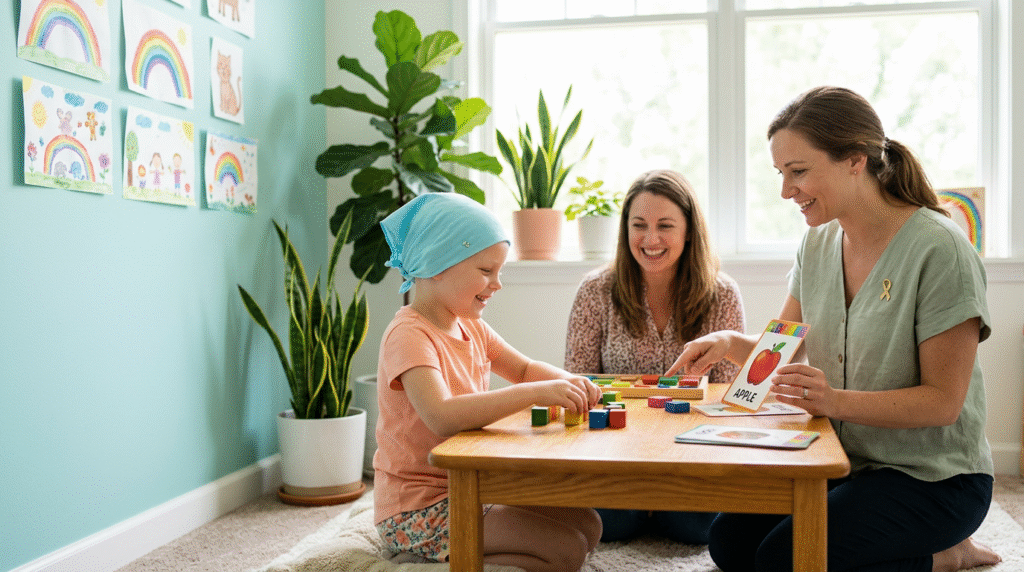
Speech-language pathologists and psychomotor therapists can play an important role in supporting children during and after cancer treatment.
Depending on the child’s individual needs, therapy may focus on:
Therapy can support vocabulary, comprehension, verbal expression, and the more complex language abilities children need for school, relationships, and everyday communication.
Children whose treatment affects the mouth, throat, vocal cords, or related structures may need support to improve speech clarity or voice.
Some children experience difficulties swallowing safely or maintaining adequate nutrition.
Speech-language therapy can support feeding and swallowing through appropriate exercises, food-texture strategies, and safe-swallow techniques based on the child’s individual needs.
Structured and play-based therapeutic activities can help children work on attention, memory, planning, organization, and other executive-function skills.
After extended periods of treatment or isolation, some children may need additional support reconnecting with peers, participating in conversations, and rebuilding confidence in everyday social interactions.
Early, individualized intervention, developed in coordination with the child’s oncology and healthcare team, can support recovery and help children continue progressing developmentally.
Because some effects of childhood cancer treatment may emerge or become more noticeable years later, ongoing follow-up can remain important even when a child initially appears to be doing well.
Parents are often managing their own shock, grief, uncertainty, and exhaustion while trying to provide stability for their child.
Several approaches can help support a child’s communication, development, and emotional wellbeing during this period.
Children generally benefit from truthful information presented in language appropriate for their age and level of understanding, even when the information is difficult.
Even small or adapted versions of a child’s usual routines can provide comfort and support healthy development during treatment.
Helping children remain connected with friends, siblings, school, and familiar activities, including virtually when necessary, can support their social and emotional wellbeing.
Caregivers also need opportunities to receive support. Encouraging parents to rely on family, friends, support networks, psychologists, social workers, and other professionals when needed can benefit the entire family.
Childhood cancer can affect much more than a child’s physical health. For some children, its effects can extend to speech, language, swallowing, cognition, motor development, learning, emotional wellbeing, and social communication.
These challenges may appear during treatment, after treatment, or years later as developmental and academic demands increase.
As a clinic working with children across communication, developmental, and psychomotor needs, we can be part of the multidisciplinary care team supporting these children and their families.
Through individualized assessment, therapy, continued monitoring, and collaboration with the child’s medical team, speech-language pathologists and psychomotor therapists can help children strengthen the skills they need to communicate, learn, participate, and reconnect with everyday life.
Written by: Joevana El Howayek
Reviewed by: Reine Bou Issa
International Agency for Research on Cancer (IARC) — Childhood Cancer Awareness Month 2026
Communication during childhood cancer: Systematic review of patient perspectives — PubMed
National Cancer Institute — Support for Families: Childhood Cancer
Development of Communication and Language Skills in Children with Hematological–Oncological Disorders — PMC
speechtherapy.org — The Role of Speech Therapy in Treating Children with Cancer
Mayo Clinic News Network — Supporting Your Child’s Development After a Cancer Diagnosis
“Chemobrain” in childhood cancer survivors — the impact on social, academic, and daily living skills — PMC
Head and Neck Cancer Australia — Speech, Voice and Swallowing
Coça et al. (2020) — Incidence and risk factors of communication, swallowing, and orofacial myofunctional disorders in children and adolescents with cancer