

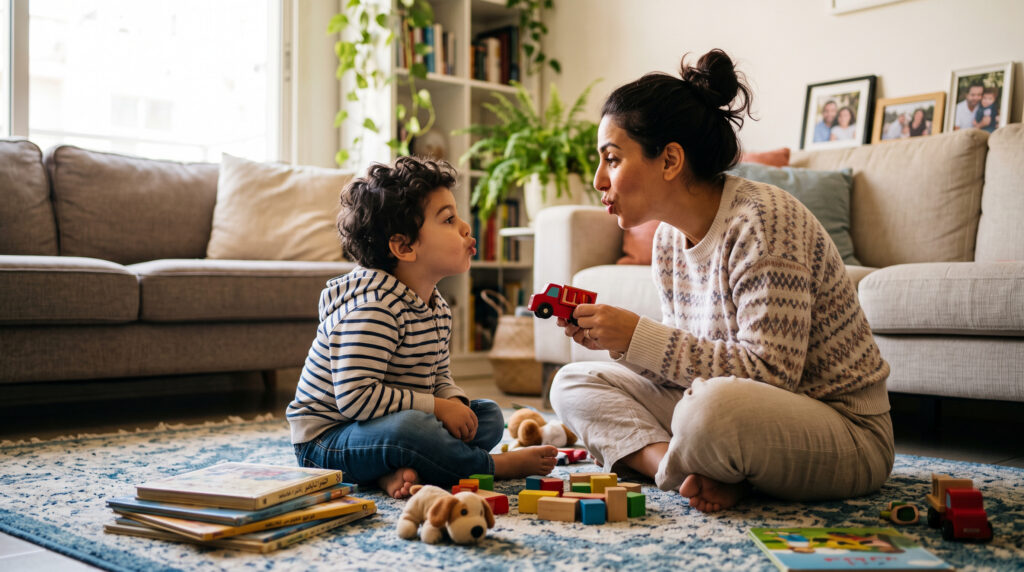
Childhood Apraxia of Speech (CAS) is more than a speech sound difficulty. Children with CAS know what they want to say, but their brain has difficulty planning and sequencing the precise movements needed to produce speech clearly and consistently.
Because the signs of childhood apraxia of speech can overlap with other speech sound disorders, identifying CAS can sometimes be challenging, particularly in younger children. Understanding its symptoms, possible causes and impact on communication can help parents know when to seek professional support.
Childhood Apraxia of Speech (CAS), sometimes referred to as Developmental Verbal Dyspraxia or Developmental Apraxia of Speech, is a serious speech sound disorder in children that remains only partially understood by researchers.
Its defining feature is difficulty planning and sequencing the physical movements involved in producing speech.
In other words, the child may know the word they want to say, but coordinating the movements required to produce it accurately can be difficult.
Children with CAS commonly display a combination of speech characteristics rather than one isolated symptom.
Common signs of childhood apraxia of speech include:
Difficulty producing vowel and consonant sounds accurately
Inconsistent speech errors, where the same word or syllable may sound different each time the child attempts it
Unusual speech rhythm, stress or intonation
Choppy or disrupted transitions between sounds and syllables
Reduced accuracy as words become longer or more complex
A smaller range of speech sounds, particularly when speaking more quickly
The presentation can vary considerably from one child to another, which is one reason a professional speech and language assessment is important.
Evidence suggests that Childhood Apraxia of Speech rarely appears completely in isolation. CAS is frequently associated with broader functional challenges extending beyond speech sound production and affecting different aspects of language and communication.
This is particularly important as children grow and encounter more complex language, literacy and academic demands.
CAS may be present from birth or develop later in childhood.
It tends to appear under several different circumstances:
In some children, there is no clearly identifiable neurological cause or underlying condition.
Childhood Apraxia of Speech may occur alongside broader neurobehavioral or genetic conditions, including autism, epilepsy, Fragile X syndrome, Rett syndrome and Prader-Willi syndrome.
In other cases, speech motor planning difficulties may follow an identifiable neurological event, such as a stroke before or shortly after birth, infection, physical trauma or surgical removal of a brain tumor.
Diagnosing Childhood Apraxia of Speech is not always straightforward.
During the preschool years, CAS can closely resemble other severe speech sound disorders, making it difficult to distinguish between them.
Some of the characteristics more strongly associated with CAS, including difficulties sequencing syllables, abnormal prosody and distinct speech sound patterns, may become easier to identify once a child reaches school age.
A speech-language pathologist can assess the child’s speech production, sound patterns, motor planning and other communication skills to determine whether their difficulties are consistent with CAS.
There is ongoing discussion about whether CAS reflects difficulties exclusively within the motor planning system or whether language processing is also involved.
Some experts argue that Childhood Apraxia of Speech involves challenges affecting both motor planning and aspects of the language system.
Supporting this idea, children with CAS may experience difficulty with phonological awareness tasks, including recognizing rhymes and identifying individual syllables within words.
These abilities are important not only for speech, but also for the later development of reading and spelling.
Children with CAS may experience difficulties extending beyond spoken communication.
Research comparing spelling abilities found that children with Childhood Apraxia of Speech performed worse in spelling than peers with typical speech who had similar reading levels.
The difference was not explained simply by difficulty saying the words or matching letters with sounds. Researchers instead pointed toward underlying challenges with distinguishing and analyzing speech sounds.
As a result, some children with CAS may experience difficulties with:
Phonological awareness
Reading
Spelling
Written language
Broader academic tasks
Monitoring literacy development can therefore be an important part of supporting a child with CAS.
Children diagnosed with CAS typically require ongoing and repeated sessions with a speech-language pathologist.
Therapy may continue over several years depending on the child’s individual needs and the severity of their speech difficulties.
Because CAS involves difficulty planning and coordinating speech movements, intervention often requires frequent and structured practice.
Both treatment approaches focusing on physical speech sound production and approaches addressing language structure have demonstrated positive results.
Since therapy may involve sustained individual treatment, families can also face practical challenges related to time commitment and cost.
At its core, CAS occurs because the brain systems responsible for planning and issuing motor commands for speech are underdeveloped or damaged.
This disrupts the planning required to produce precise speech movements.
Practically, this can make it difficult for a child to reliably position and coordinate the parts of the mouth involved in speaking, including the face, tongue, lips and jaw, and to sequence these movements smoothly into syllables and words.
The American Speech-Language-Hearing Association (ASHA) identified three hallmark characteristics associated with Childhood Apraxia of Speech in its 2007 position statement:
Inconsistent speech errors: The child may produce the same sounds, syllables or words differently across repeated attempts.
Difficulty transitioning between sounds and syllables: Moving smoothly from one speech sound to another can be difficult and may involve noticeable articulatory effort.
Unusual stress and rhythm: The child may use stress, rhythm or intonation differently, sometimes making speech sound unusually flat or giving equal emphasis to syllables.
These signs should be considered as part of a comprehensive assessment rather than used by parents to diagnose CAS independently.
Parents can play an important role in supporting communication outside speech therapy. Home activities should complement the child’s individualized treatment plan rather than replace professional intervention.
Instead of relying only on yes/no questions, offer simple choices.
For example, instead of asking, “Do you want an apple?” try:
“Do you want an apple or cheese?”
This creates a natural opportunity for communication.
Prioritize words that are useful and meaningful in your child’s everyday life.
These may include the names of favorite people and pets, favorite toys and functional words such as:
“no,” “mine,” “stop,” “help,” “all done,” “eat” and “potty.”
Repeatedly asking children questions can create unnecessary pressure.
Instead of asking, “What color is it?” you might say:
“The truck is red. Beep beep!”
This allows the child to hear and experience language without being required to respond.
Try to position yourself where your child can see your face while you talk, play or read together.
Watching how the mouth moves can help children observe the physical patterns involved in speech production.
When modeling speech, use shorter and simpler phrases.
Fewer words can make it easier for the child to focus on individual sounds and syllables.
Animal noises, vehicle sounds, sound effects and simple exclamations often contain easier syllable shapes.
They can naturally be incorporated into playtime, bath time, reading or car journeys.
Rather than repeatedly asking your child to say a particular word, model the word yourself.
Pressure to speak can sometimes make a child less willing to attempt communication.
Choose familiar books and songs containing repetition.
Pause immediately before a familiar final word and give your child an opportunity to complete it if they want to.
Rather than trying to practice many words simultaneously, narrow structured practice to approximately five target words selected together with your child’s speech-language pathologist.
Outside these targeted practice opportunities, continue providing a strong and natural speech model.
For selected target words, try saying the word together with your child at the same time.
Slowing your speech can help highlight the smooth, connected movements required to transition between sounds.
If your child’s speech is consistently difficult to understand, their pronunciation varies considerably when repeating the same words, or you notice unusual rhythm, stress or difficulty moving between sounds, consider discussing these observations with a qualified speech-language pathologist.
Early assessment can help identify the nature of the child’s speech difficulty and determine what type of intervention may be appropriate.
Childhood Apraxia of Speech can affect much more than pronunciation. For some children, its impact may extend into language, literacy and academic development. With appropriate assessment, individualized speech therapy and consistent support at home, children can work toward developing clearer and more effective communication.
Written By: Lea Maroun
Reviewed By: Joevana El Howayek & Reine Bou Issa