

Back to school checklists are usually all about uniforms, stationery and schedules. There is a quieter kind of readiness that matters just as much: can your child manage the physical demands of a school day on their own?
Opening a lunchbox. Holding a pencil. Zipping a jacket after PE. These small movements add up to big confidence in the classroom, and they are easy to overlook until the first week of term makes them visible. Below are five quick checks, informed by occupational therapy and psychomotor therapy, that you can run through at home in about five minutes.
Fine motor control is not only about neat handwriting. It underpins how long a child can write before their hand tires, which affects how much they produce in a lesson and how much of their attention is left for thinking rather than for gripping.
Self-help skills carry a different weight. They are the moments when a child is visible to peers: the only one who cannot open their yoghurt, the last one still struggling with a jacket while the class lines up. Those moments shape how a child feels about school long before any academic work does.
Both sets of skills develop together, and both respond well to short, regular practice at home.
Watch how your child holds a crayon or pencil. A relaxed tripod grip, using thumb, index and middle finger, makes handwriting far less tiring across a full school day than a fisted or flat-palm hold.
Look for a relaxed hand rather than white knuckles, movement coming from the fingers rather than the whole arm, and the paper being steadied with the other hand.
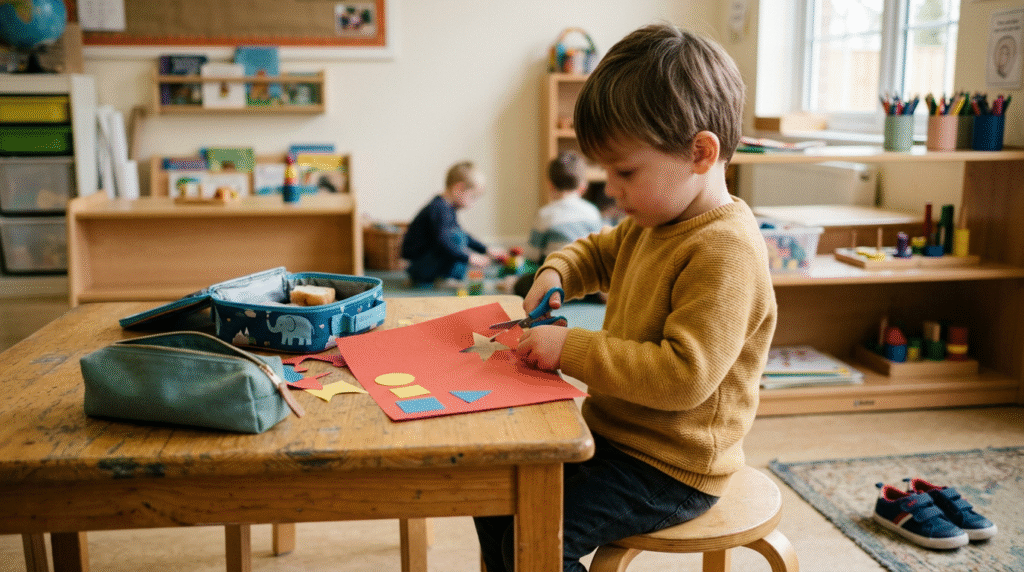
Can your child snip along a straight line, or cut out a simple shape? Controlled scissor use builds the same hand strength and bilateral coordination that later supports neat, efficient handwriting.
Watch whether the paper-holding hand turns the page as they cut. That rotation is a coordination skill in its own right and often the missing piece.
Jackets, lunch bags and pencil cases mean school days are full of things to open and close. Practising at home means your child is not learning this for the first time in front of classmates.
Large buttons are easier than small ones, and starting a zipper is harder than pulling it up, so a child who can do one may still need help with the other.
Whether it is tying laces or managing velcro straps confidently, being able to sort out their own shoes saves stress at drop-off and after PE.
In the UAE this comes up more often than parents expect, because shoes come on and off repeatedly across a day: PE, swimming, indoor play areas and prayer spaces. Independence here pays back several times daily.
Can your child open their own containers, manage wrappers and organise items back into the bag? A lunchbox that cannot be opened is a lunch that is not eaten, and hunger shows up as behaviour in the afternoon.
Check the bag itself too. A backpack that is sized correctly and worn on both shoulders, sitting above the hips, protects posture and shoulder development across the school year.
These are broad guides, not tests. Children vary, and a skill that has simply never been practised is not the same as a skill that is difficult.
None of these skills need to be perfect at the start of term. A quick check now simply shows you where a little extra practice at home could make the first weeks easier.
Practical ways to build them through everyday routines:
Short and frequent beats long and occasional. Five minutes most days will do more than a half-hour session on a Sunday.
For more hands-on ideas built around play, see our earlier post, Strong Fingers, Strong Foundations, which covers fine motor activities you can fold into daily routines at home.
Consider raising it with an occupational therapist or psychomotor therapist if:
Avoidance in particular is worth taking seriously. Children rarely avoid something they find easy, so persistent avoidance is usually information rather than preference.
Fine motor and self-help skills do not develop on their own, and they matter because they build a child’s independence and confidence across the whole school day. These are exactly the skills our psychomotor and occupational therapists work on in sessions, because fine motor control, self-help skills and classroom confidence grow together.
If you want a clearer picture of where your child is right now, our team in Dubai is ready to help, in Arabic and English.
Build hand strength first through play dough, tongs and vertical drawing, then introduce grip. Correcting grip directly before the underlying strength is there usually fails and creates resistance.
Not at all. These skills develop across the early school years, and short daily practice at home works at any point in the term.
Time pressure and being watched change everything. Practise under mild time pressure at home, for example opening the lunchbox while you count, so the school version feels familiar.
Sometimes they help, but they are a support rather than a solution. An occupational therapist can tell you whether a grip aid fits your child’s specific difficulty or simply masks it.
Indirectly, yes. A child whose hand tires quickly writes less and spends attention on the mechanics rather than the content, which shows up in written work rather than in understanding.
If any of these five checks raised a question, an assessment gives you a clear picture and a practical plan. Contact Talking Brains Center in Dubai to speak with our occupational and psychomotor therapy team.