

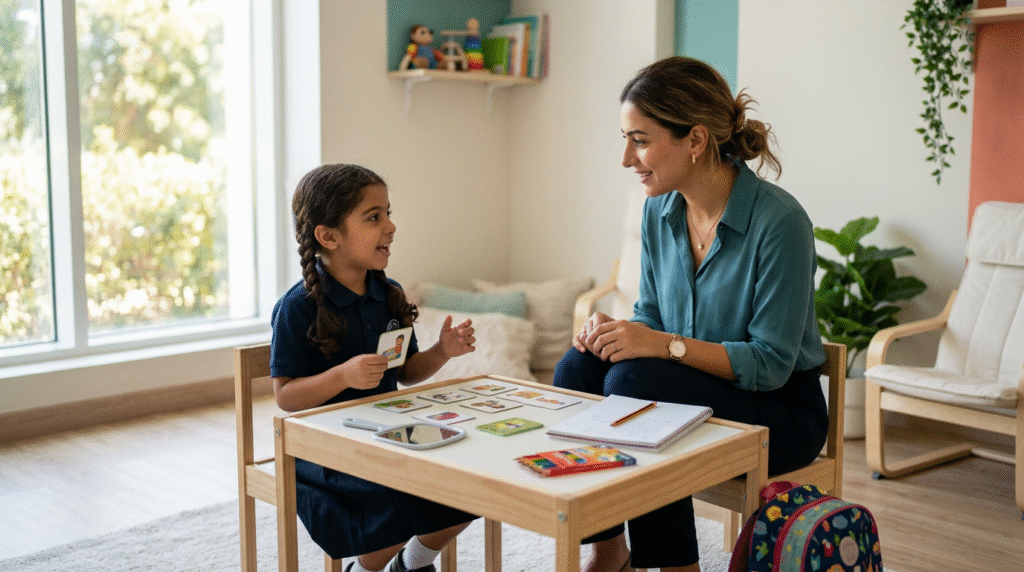
The start of a new school year in the UAE is a natural checkpoint. Uniforms are bought, routines are reset, and parents get a fresh view of how their child compares with classmates. It is also the moment when speech and language difficulties become most visible, because the classroom demands far more communication than the summer holidays ever did.
If you have been quietly wondering whether your child’s speech is on track, this is the right time to look properly rather than wait another term.
School asks a child to follow multi-step instructions, answer questions in front of peers, read aloud, negotiate in the playground, take turns in conversation and process new vocabulary at speed. A child who copes comfortably at home, where family members anticipate their needs, can struggle noticeably once those supports disappear.
This is why so many referrals to speech and language therapists in Dubai arrive in September and October. Teachers see the gap first, and parents often recognise it once they hear it described.
Every child develops at their own pace, but broad expectations are useful for spotting a genuine delay early.
Book an assessment if you notice any of the following, particularly if a teacher has mentioned them too:
Families across Dubai and the wider UAE raise children between Arabic, English and often a third home language. Parents regularly worry that bilingualism is causing a delay, and are sometimes advised to drop one language.
The evidence does not support that advice. Bilingualism does not cause speech or language disorders. A bilingual child may mix languages, may have vocabulary distributed across both languages, and may take slightly longer to appear fluent in each one. However, a genuine language disorder shows up in every language the child speaks, not just one. This is exactly why bilingual assessment matters: a therapist who evaluates only the school language can easily mistake a normal bilingual profile for a delay, or miss a real difficulty entirely.
Therapy at Talking Brains Center starts with a full assessment covering speech sounds, expressive and receptive language, social communication and, where relevant, literacy foundations. From there, the therapist builds a targeted plan.
Typical goals for school-age children include:
Therapy sessions are one or two hours a week. Home practice is where progress becomes permanent.
Waiting is the most common regret parents describe. Early intervention is consistently more effective and usually shorter than therapy started years later.
It varies with the goal and the starting point. Some articulation goals resolve in a few months, while broader language programmes are reviewed over a school year.
Sessions are scheduled around school timetables, with after-school and weekend slots available.
Yes. Talking Brains Center assesses and treats in both Arabic and English.
A single assessment gives you clarity for the whole year. Contact Talking Brains Center in Dubai to arrange a speech and language evaluation before the term gathers pace.